Energy bills
Why now is a good time to review your energy bill
A short review could give you more certainty, prevent you from paying more than you need to, and keep more money in your pocket.
There is never a bad time to check your energy bill.
Most of us set up a Direct Debit, watch the payment leave each month and get on with everything else. Unless the amount suddenly jumps, it is easy to assume there is nothing to look at.
But energy prices change. Tariffs change. And the amount of energy we use changes dramatically as the seasons turn.
That is why now feels like a particularly sensible moment to pause, understand what you are paying and see what else might be possible.
Not because you have to switch.
Not because fixing is automatically right for everybody.
Simply because a short review could give you more certainty, prevent you from paying more than you need to, and keep more money in your pocket.
The headline says 4% — but gas is doing most of the work
Ofgem has confirmed that the energy price cap will rise by 4% in October.
Four per cent may not sound dramatic. But the headline figure combines gas and electricity, and the two are moving very differently.
Electricity prices are changing only slightly. Gas unit prices are rising by almost 9%.
For households with gas central heating, that matters. The increase lands just as boilers start coming back on and gas use begins climbing towards its winter peak.
The price cap is often described as though it were a fixed annual bill. It is not. It limits the rates suppliers can charge customers on default tariffs. The amount you actually pay still depends on where you live and how much energy you use.
So the real question is not, “What is the price cap?”
It is, “What will these rates mean for my home?”
Winter changes the shape of the bill
Energy use is not spread evenly across the year.
In summer, the heating is usually off, the evenings stay light and gas use can fall to little more than hot water and cooking.
Then autumn arrives.
The lights come on earlier. The temperature drops. The heating goes back on—sometimes for an hour at first, then for longer and longer as winter settles in.
For a typical dual-fuel home, roughly two-thirds of the year’s energy is used across autumn and winter.
That makes timing important.
Saving a little on the energy you barely use in summer is helpful. Saving on the energy you are about to use throughout autumn and winter can make a much bigger difference.
The graph below shows that seasonal pattern far more clearly than a page full of numbers ever could. It separates gas and electricity, and the line across it shows the kind of equal monthly payment someone might make on a twelve-month budget plan.
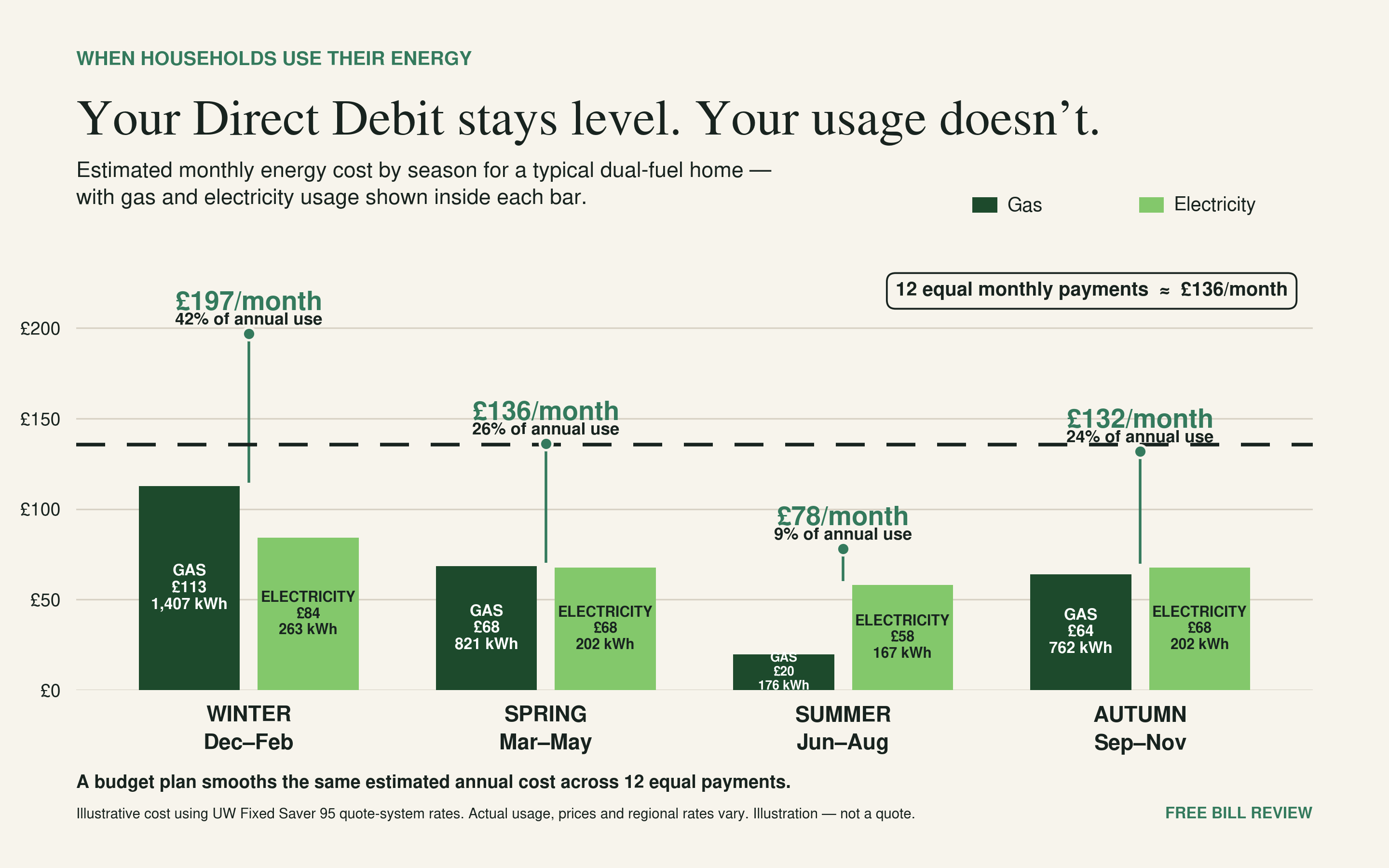
A steady Direct Debit does not mean your home uses the same amount every month. In warmer months you may build credit; in colder months you may use it. The payment is intended to smooth an uneven year into twelve more manageable amounts.
That is useful—but it can also make changes in the underlying cost of your energy less obvious.
The price cap is protection, not a special offer
Around 22 million households are still on variable tariffs affected by the price cap.
There is nothing inherently wrong with a variable tariff. It offers flexibility, prices can fall as well as rise, and staying exactly where you are may be the right answer for your household.
But the price cap is a ceiling. It is the maximum suppliers are allowed to charge on affected default tariffs, not a guarantee that you are getting the best available value.
Suppliers still compete. Fixed tariffs and tracker deals can sit below the cap. Even some variable tariffs are set fractionally below it.
That is why “I am protected by the price cap” and “I have checked I am on the right deal” are not quite the same thing.
What could fixing change?
A fixed tariff does one simple thing: it locks your unit rates and standing charges for an agreed period.
It does not make every bill identical. If you use more energy, you will still pay more. If you use less, you will pay less.
What it gives you is certainty about the prices being applied to that energy.
For some people, that certainty is reassuring. They would rather know the rates they are paying through winter than wait for the next price-cap announcement.
For others, flexibility matters more. They may prefer a variable or tracker tariff that can benefit if prices fall.
Neither choice is automatically right. The useful part is understanding the difference and deciding deliberately, rather than remaining on a tariff simply because nobody has looked at it recently.
What the comparison shows
The table below does the number-crunching so the rest of us do not have to.
It compares the current regional Ofgem cap, the confirmed October cap, the latest national January forecast from Cornwall Insight—which is not yet confirmed—and the current UW Fixed Saver 95 illustration. You can also enter the annual gas and electricity usage from your own bill and select your energy region.
Use your own figures
What could your energy cost?
Enter the annual usage shown on your latest bill. The comparison updates immediately.
How this is calculated: usage × unit rate, plus 365 days of electricity and gas standing charges. Monthly figures divide the annual estimate into 12 equal payments; an actual Direct Debit may differ.
UW eligibility: UW Fixed Saver 95 is available to eligible multiservice customers taking 3 or 4 UW services. A smart meter and other eligibility requirements apply. The illustration includes the £13 annual dual-fuel discount on each fuel.
Regional basis: Current and October rows use Ofgem’s published regional Direct Debit cap rates. January is a national forecast because no regional cap has been confirmed. Fixed Saver 95 uses a North West UW quote and does not change with the selector; UW prices vary by region.
Figures include applicable VAT, are illustrative rather than a quote, and exclude account balances and future rate changes. UW Fixed Saver 95 has a £75 exit fee per fuel.
The example is not a promise that every household will save. Prices vary by region, and your consumption may be very different from the “typical” home.
It is there to show the art of the possible.
For the North West example, the fixed tariff comes out below both the current regional cap and the confirmed October regional cap. It also offers protection if the January cap rises as currently forecast.
That may make fixing attractive—but the contract length, exit fees, services required and your actual usage all matter. A proper comparison should include all of them.
There is no pressure hidden in a review
I know energy can feel unnecessarily complicated.
There are unit rates, standing charges, forecasts, regions, tariff names, discounts and Direct Debits that do not always match the energy used that month.
You should not have to become an energy expert to work out whether you are paying a fair amount.
That is the point of a free bill review.
I start with what you have now and the annual usage shown on your bill. I can then explain what the confirmed price changes mean for your household and show you what Utility Warehouse could offer.
Sometimes the answer will be to switch now.
Sometimes it will be to wait.
Sometimes it may make sense to change one thing but not another.
And sometimes staying exactly as you are will be the sensible outcome.
The decision remains yours. My job is to make the options understandable enough for you to make it comfortably.
Ten minutes could be enough to know
There is never a bad time to check that you are not overpaying.
But with gas prices rising, the heating season beginning and another price-cap increase currently forecast for January, this is a particularly useful time to look.
A review can take as little as ten minutes when you have a recent bill available. There is no obligation to change anything and no complicated sales pitch.
At worst, you confirm that your current arrangement is right for you.
At best, you keep more of your own money in your pocket—and head into winter knowing exactly what you have chosen and why.
Book a free bill review , or send me your latest energy bill and I will take a look.
Disclosure
This is an independent website operated by Dan Smith, an authorised Utility Warehouse Partner and Team Leader. It is not the official Utility Warehouse website. My free bill review considers whether Utility Warehouse services may suit your household; it is not a whole-of-market comparison. I may receive commission if you become a Utility Warehouse customer through me.